CPA for Construction Contractors
Job costing that ties to the general ledger, WIP schedules a surety will accept, and contract method selection that doesn't tax you on money you haven't collected. For general contractors and subs across Texas.
Contractors Don't Go Broke on Bad Jobs — They Go Broke Not Knowing Which Jobs Are Bad
Construction is the industry where the accounting is the business. A restaurant owner can feel a bad month. A contractor can run eighteen months of losing work and still show profit on the income statement, because revenue recognition on long-term contracts depends entirely on estimates — and if the estimated cost to complete is wrong, every number downstream is wrong with it.
That's why we start with the tie-out. Job cost reports and the general ledger have to agree. Labor burden has to be allocated to jobs, not buried in overhead. Change orders have to hit the contract value when they're approved, not when they're invoiced. Until that's true, the WIP schedule is fiction, the surety knows it, and the bonding line stays smaller than your capacity deserves.
From there the tax work gets straightforward: choosing the contract method you qualify for under Section 460, planning around retainage recognition, and timing equipment purchases against high-margin years. And when a bonding company or bank asks for statements, we prepare them — compiled or reviewed, from a firm with a peer review rating of pass.
- Job costing reconciled to the general ledger
- WIP schedules with over/underbilling analysis
- Labor burden and equipment rate allocation
- Section 460 contract method selection
- Retainage recognition and cash planning
- Reviewed statements for surety bonding
- Section 179 and equipment purchase timing
- Subcontractor 1099 compliance
Built Around How Contractors Actually Operate
Project & Job Costing
A cost code structure you'll actually use, direct labor burdened at a real rate, equipment charged to jobs at an hourly rate that recovers ownership cost, and committed-cost tracking so a blown budget shows up at 40% complete instead of at closeout.
WIP Schedules & Overbilling
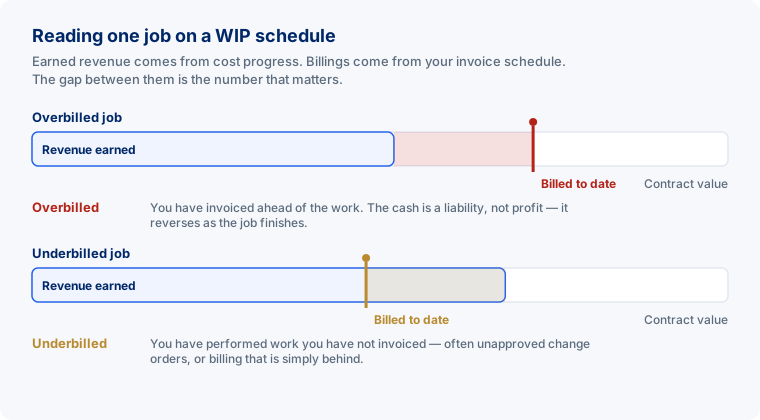
Monthly work-in-progress reporting: costs to date, estimated cost to complete, percent complete, earned revenue, and billings. You see which jobs are fading, which are overbilled, and how much of your cash is really other people's money.
Statements for Bonding
Surety underwriters read working capital, net worth, and the WIP schedule. We prepare reviewed or compiled financial statements with the supplementary schedules they expect — and we'll take the underwriter's phone call.
Contract Method Planning
Percentage-of-completion, completed contract, accrual excluding retainage — which you qualify for depends on gross receipts and contract type, and which you should elect depends on your margins and growth. We model it before the election locks in.
Equipment & Fleet
Section 179 and bonus depreciation timed against high-income years, buy-versus-lease analysis on iron, and equipment cost recovery rates that put real ownership cost into your bids instead of your overhead.
Subcontractor Compliance
W-9 collection before the first check clears, 1099-NEC filing, and worker classification review — because a sub who looks like an employee to the IRS or the Texas Workforce Commission becomes your payroll tax problem.
Four Expensive Habits We See Constantly
Overhead that never reaches a job
Payroll taxes, workers' comp, small tools, fuel, and truck costs left sitting in overhead instead of burdened into direct labor and equipment rates. Every bid built on those numbers is underpriced, and the shortfall only shows up as a thin year with no explanation.
Profit borrowed from the future
Front-loading billings feels like good cash management, and it is — right up until the overbilling reverses and a job that "made money" for three quarters gives it all back in the fourth. Without a WIP schedule you can't see it coming.
Tax on retainage you haven't collected
Depending on your method, retainage can be income long before the check arrives. Contractors with 10% held across several large jobs routinely face a tax bill funded entirely out of working capital they needed for the next mobilization.
Bonding capacity left on the table
Sureties underwrite conservatively when the financials are unaudited, internally prepared, or inconsistent with the WIP. Clean, professionally prepared statements frequently move the bonding line more than another good year of results does.
Construction Accounting Questions
Why does my surety company want reviewed financial statements?
Bonding capacity is underwritten primarily on working capital and net worth, and a surety will not take those numbers from an unaudited internal report. A review engagement gives them limited assurance from an independent CPA plus a work-in-progress schedule showing your open jobs, costs incurred, billings, and estimated cost to complete. Our firm performs review and compilation engagements and carries an AICPA peer review rating of pass.
What is a WIP schedule and why does it matter so much?
A work-in-progress schedule lists every open contract with its contract value, costs incurred to date, estimated cost to complete, percentage complete, revenue earned, and amounts billed. It reveals whether you're overbilled or underbilled on each job. Sureties and banks read it before they read the income statement, because it shows whether your reported profit is real or borrowed from future work.
Do I have to use percentage-of-completion for tax?
Not always. Section 460 generally requires percentage-of-completion for long-term contracts, but there are important exceptions — a small contractor exception based on average annual gross receipts (a threshold that's indexed and changes over time), and a separate exception for home construction contracts. Which method you qualify for and which one benefits you are two different questions, and the answer can shift as your revenue grows. We look at it annually rather than assuming last year's answer still holds.
When is retainage taxable?
It depends on your overall method of accounting and the contract method used. Retainage receivable is frequently recognized before you have the cash in hand, which is one of the most common reasons a profitable contractor has a tax bill and no money to pay it. There are planning options — we'd rather set them up in October than explain the problem in March.
My job costing never ties to my financial statements. Is that normal?
It's extremely common and it's a real problem. When job cost reports and the general ledger disagree, you can't trust either one, your WIP schedule is unreliable, and your bonding suffers for it. Fixing the tie-out between job costing and the GL is usually the single highest-value engagement we do for a contractor, and it typically pays for itself in bidding accuracy alone.
Should my construction company be an S-corp?
Often yes, once profit is consistently well above what you'd pay yourself as a reasonable salary — but construction adds a wrinkle most S-corp analyses ignore. Bonding capacity depends on retained net worth, and distributions pull equity out of the balance sheet the surety is underwriting. We model the self-employment tax savings against the bonding impact, not just the tax return. Try the S-corp calculator for a first look.
From Our Blog
How to Read a WIP Schedule (And What Your Surety Sees)
Overbillings, estimated cost to complete, job fade — and the four things an underwriter looks for before they read your income statement.
Read the article →Why Profitable Contractors Run Out of Cash
Retainage is frequently taxable income before you collect it. How the timing works and what to do about it before year-end.
Read the article →Let's Look at Your WIP Schedule
Send us your last WIP report and a recent job cost summary. We'll tell you whether they tie, what your surety is likely seeing, and where the margin is leaking — before you commit to anything.
Related: Spec home builders · Rental property owners