CPA for Salons & Barbershops
Booth rent versus employee — the one decision that shapes your entire tax picture — plus tip handling, Texas sales tax on retail product, and S-corp timing that's based on your numbers instead of someone's advice at a trade show.
Almost Every Salon Tax Problem Traces Back to Classification
There are two legitimate ways to run a salon, and they're completely different businesses for tax purposes. As a booth rental shop you're effectively a landlord: stylists are independent, they pay you rent, they keep what they earn, and you report rent income. As a commission or employee shop you own the revenue and the client relationship, and your stylists are W-2 employees with payroll, withholding, and unemployment tax.
The trouble starts in the middle — and most shops we meet are somewhere in the middle. The owner sets the hours, sets the prices, supplies the color, takes the payment at the front desk, and pays out a percentage, but calls everyone a booth renter to avoid payroll. That arrangement doesn't survive contact with the IRS or the Texas Workforce Commission, and the bill arrives as back payroll tax plus penalties, usually triggered by one stylist filing for unemployment.
Get the model right and the rest falls into place: sales tax on retail product handled with a proper permit and resale certificate, tips reported correctly, product inventory tracked, and an S-corp election made when the numbers justify it rather than because someone at a hair show said to.
- Booth rent vs. employee classification review
- Stylist agreements that match how you actually operate
- Payroll setup for commission and hourly stylists
- Tip reporting and withholding
- Texas sales tax on retail product sales
- Product inventory and back bar cost tracking
- Schedule C and S-corp returns for independent stylists
- Suite and chair rental income reporting
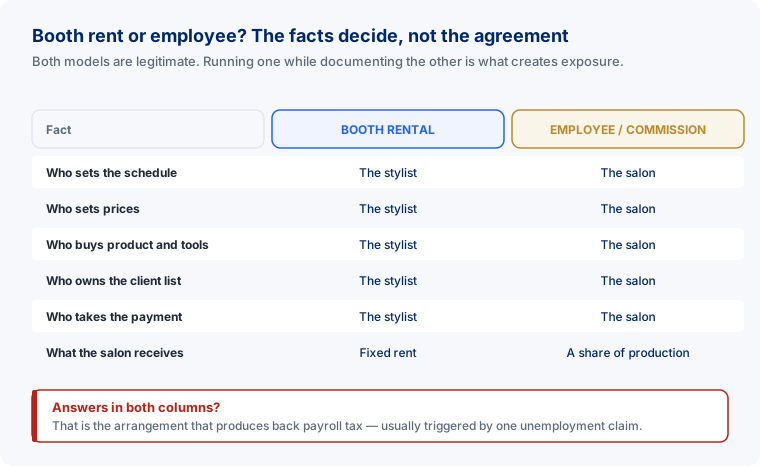
Booth Rent vs. Commission — What Actually Separates Them
Neither model is better. Running one while documenting the other is what causes trouble.
A real booth rental shop
- Stylist sets their own hours and prices
- Stylist buys their own product and tools
- Stylist books and owns their own clients
- Stylist collects payment from their own clients
- Fixed rent paid regardless of earnings
- Salon reports rental income; no payroll
- Each stylist files their own Schedule C
A commission / employee shop
- Salon sets the schedule and the price list
- Salon supplies color, back bar, and equipment
- Salon owns the client list and the booking system
- Salon takes payment and pays out a percentage
- Stylists are W-2 employees
- Payroll, withholding, and unemployment tax apply
- Tips run through payroll and are reported
For Shop Owners and Independent Stylists Alike
Classification Review
We look at how your shop actually operates — not what the agreement says — and tell you which model you're really running, what the exposure is if they don't match, and how to fix it going forward without blowing up your team.
Independent Stylist Returns
Booth renters and suite owners: Schedule C done properly with product, tools, education, booth rent, liability insurance, and the home office if you have one — plus quarterly estimates so April isn't a shock.
Texas Sales Tax
Services generally aren't taxable in Texas; retail product is. We get you permitted, set up the resale certificate for product you buy to resell, and split service from retail revenue in the books so the remittance is right.
Payroll & Tips
Commission payroll configured correctly, tips reported and withheld on, and a clear-eyed answer on the FICA tip credit — which salons, unlike restaurants, don't qualify for no matter how heavily tipped the shop is.
Product & Back Bar
Retail inventory separated from back bar consumables, so you know your retail margin and aren't quietly deducting inventory you still have on the shelf — a small distinction that changes the return more than owners expect.
S-Corp Timing
An S-corp election is a numbers question, not a status symbol. We model the self-employment tax saved against payroll and compliance cost, and tell you plainly if you're not there yet.
Salon & Barbershop Questions
Booth rent or employee — which model should my salon use?
They're fundamentally different businesses. Under booth rent the salon is essentially a landlord: stylists are independent, they pay you rent, they keep their own service revenue, and you report rental income. Under a commission or employee model the salon owns the client relationship and the revenue, and the stylist is a W-2 employee with payroll, withholding, and unemployment tax. Either is fine. The danger is running an employee arrangement while calling it booth rent, which exposes the salon to back payroll taxes and penalties.
What makes a stylist a real booth renter?
Substance, not the label on the agreement. Genuine booth renters typically set their own hours and prices, buy their own product and tools, book and keep their own clients, and pay a fixed rent regardless of how much they earn. Where the salon sets the schedule, sets prices, supplies product, takes the payment, and pays out a percentage, both the IRS and the Texas Workforce Commission are likely to see an employee no matter what the contract says. A signed independent contractor agreement is not a defense on its own.
Does my salon owe Texas sales tax?
On retail products, generally yes. Haircutting and most personal-care services aren't subject to Texas sales tax, but shampoo, styling product, and tools sold to a client are taxable retail sales. That means a sales tax permit, a resale certificate for product you buy to resell, and books that separate service revenue from retail revenue. Salons that never split the two either overpay or underreport, and both get corrected eventually — usually on audit.
Can a salon claim the FICA tip credit like a restaurant?
No. The Section 45B credit for employer social security and Medicare taxes on tips applies to food and beverage establishments where tipping is customary. Salons and barbershops don't qualify, despite being heavily tipped businesses. It's a common misunderstanding — we've seen it claimed in error — and claiming it creates an exposure rather than a benefit. Restaurants, on the other hand, should absolutely be claiming it.
When does an S-corp make sense for a stylist?
Once profit is consistently high enough that the self-employment tax saved exceeds the cost of payroll, an extra return, and the compliance overhead — and once income is stable enough that a reasonable salary can be paid all year. For a booth renter with modest net income, an S-corp usually costs more than it saves. For an established stylist with a full book or an owner running several chairs, the math often turns favorable. The S-corp calculator gives you a first estimate.
I rent a suite. Am I a business or just self-employed?
Both, in effect — you're a sole proprietor filing Schedule C unless you've formed an entity, which means self-employment tax on your net profit and quarterly estimated payments. The upside is that suite renters have real deductions most people miss: suite rent, product and back bar, tools and shears, continuing education and licensing, liability insurance, booking software, card processing fees, and mileage to education events. Done well, it makes a meaningful difference.
From Our Blog
Booth Rent vs. Employee: The Decision That Changes Everything
The facts that actually distinguish the two models, how the problem surfaces via an unemployment claim, and two honest ways to fix it.
Read the article →Texas Sales Tax for Salons: Services vs. Retail
The permit, the resale certificate, back bar versus retail inventory, and what to do if you've been selling product without collecting.
Read the article →Not Sure Your Stylists Are Classified Right?
It's the cheapest problem to fix before anyone files for unemployment and the most expensive one afterward. Tell us how your shop runs and we'll tell you where you stand.
Related: Restaurants & bars · All tax services