CPA for Rental Property Owners
From one duplex to a portfolio: depreciation done right, passive loss rules navigated legitimately, short-term rental treatment, and exit planning that doesn't hand the gain back in taxes.
The Deduction Isn't the Problem — Being Allowed to Use It Is
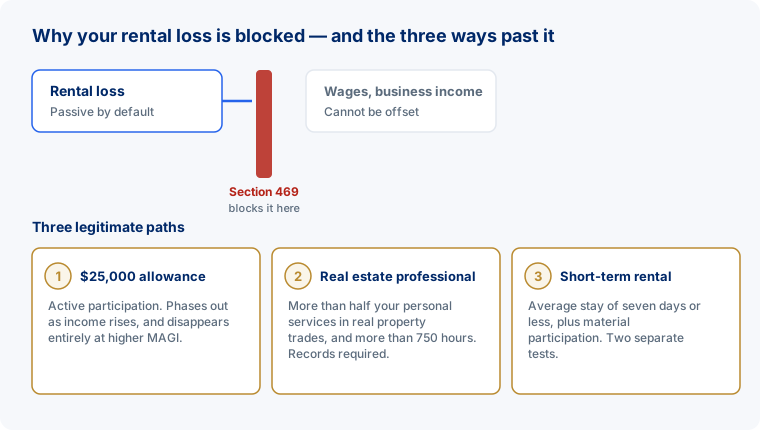
Most rental owners come to us with the same frustration: the property shows a loss on paper, and the loss doesn't reduce their tax bill. That's Section 469 doing exactly what it was written to do. Rental activities are passive by default, passive losses offset only passive income, and the $25,000 special allowance that helps smaller landlords phases out entirely at higher incomes.
There are legitimate paths through this — real estate professional status, the short-term rental rules, grouping elections, and using suspended losses on disposition. Every one of them depends on facts and documentation rather than on a checkbox, and each is a favorite IRS examination target. We'd rather set the record up correctly during the year than defend a reconstructed time log later.
The rest is craft: depreciation schedules that survive a sale, repairs versus improvements applied under the tangible property regulations, basis tracked across refinances and improvements, and 1031 exchanges planned before the property goes under contract — not after, when it's already too late.
- Schedule E preparation for any number of properties
- Passive activity loss planning and suspended loss tracking
- Real estate professional status analysis and documentation
- Short-term rental (Airbnb / VRBO) treatment
- Cost segregation evaluation — before you pay for a study
- Repairs vs. improvements and safe harbor elections
- Section 1031 like-kind exchange planning
- Depreciation recapture modeling before you sell
Where Landlords Gain and Lose the Most
Passive Loss Strategy
We map your income against the $25,000 allowance phase-out, evaluate whether real estate professional status or short-term rental treatment is realistically available to you, and track suspended losses so they're actually claimed when a property is sold.
Short-Term Rentals
Average stay of seven days or less takes the activity outside the rental definition in the passive loss rules. Combined with material participation, that can make losses non-passive without real estate professional status — but the hours have to be real and recorded.
Cost Segregation Analysis
We evaluate whether a study will actually produce usable deductions for you before you spend money on one. Accelerating depreciation into a year where the loss just suspends is a common and avoidable waste.
Repairs vs. Improvements
Betterments, restorations, and adaptations get capitalized; ordinary maintenance doesn't. We apply the tangible property regulations and make the de minimis and small taxpayer safe harbor elections on a timely return, where they have to be made.
1031 Exchanges
Planned before listing, not after closing. Identification deadlines, qualified intermediary coordination, boot analysis, and carryover basis tracking — plus an honest conversation about whether deferring is better than paying in your situation.
Exit & Recapture Planning
Unrecaptured Section 1250 gain surprises more sellers than any other item. We model the full tax on a sale — recapture, capital gain, net investment income tax, and released suspended losses — before you sign a contract.
Five Things We Fix on Nearly Every New Rental Client
Land never separated from building
Depreciating the full purchase price including land is both wrong and audit-obvious. It also understates gain on sale in a way that compounds every year the error runs.
Basis lost across refinances and improvements
Capital improvements paid out of pocket over a decade, never added to basis, and unrecoverable at closing because nobody kept the schedule. This one costs real money at exit.
Suspended losses forgotten at sale
Years of disallowed losses that should free up on a fully taxable disposition — but only if someone tracked them and knows to claim them.
Real estate professional claimed without records
The status is legitimate and valuable. Claimed on a return with no contemporaneous time log and a full-time W-2 job in another field, it's an examination waiting to happen.
Short-term rental rules misapplied
The seven-day average stay test and the material participation test are two separate hurdles. Clearing one and assuming you've cleared both is the most common error we see in this area.
Rental Property Tax Questions
Why can't I deduct my rental loss?
Rental activities are generally passive under Section 469, and passive losses can only offset passive income. There's a special allowance of up to $25,000 for taxpayers who actively participate, but it phases out over a modified adjusted gross income range and is fully gone at higher incomes. Losses you can't use are suspended and carried forward — they aren't lost, and they generally free up when you dispose of the property in a fully taxable sale. The planning question is whether you can accelerate that, not whether the deduction exists.
What is real estate professional status and do I qualify?
It requires that more than half of your personal services during the year are performed in real property trades or businesses in which you materially participate, and that you perform more than 750 hours of such services. Meeting it means your rentals are no longer automatically passive. It's a high bar, it's heavily litigated, and it requires contemporaneous time records — not a log reconstructed at filing time. If you have a full-time job outside real estate, the first test is usually the one that fails.
Are short-term rentals treated differently?
Yes. If the average period of customer use is seven days or less, the activity isn't a rental activity for purposes of the passive loss rules. Material participation is then tested under the normal rules, and an owner who materially participates may be able to treat the activity as non-passive without qualifying as a real estate professional. This is a legitimate and well-established position — but the average stay calculation and the participation hours both need to be documented, and using a management company usually undercuts the participation argument.
Is a cost segregation study worth it?
Sometimes. A study reclassifies portions of a building into shorter-lived asset classes and accelerates depreciation. The benefit is a timing benefit, and it only helps if you can actually use the deductions — which brings you straight back to the passive loss rules. We run that analysis before recommending a study, because paying several thousand dollars to create a suspended loss carryforward helps the study provider more than it helps you.
Is that repair deductible or does it have to be capitalized?
The tangible property regulations govern this. Betterments, restorations, and adaptations to a new use must generally be capitalized; amounts that keep the property in ordinary operating condition may be deducted. There are also safe harbors — a de minimis safe harbor and a safe harbor for small taxpayers among them — that can allow current deduction of items that would otherwise be capitalized. They require elections, and the elections have to be made on a timely filed return, which is one reason extensions and late filings quietly cost landlords money.
Should I put my rentals in an LLC or an S-corp?
An LLC is common and generally harmless — a single-member LLC is disregarded for federal tax, so the rental still lands on Schedule E and nothing changes tax-wise. Putting appreciated real estate into an S-corp is a different matter and is usually a mistake: getting property back out of an S-corp is a taxable event, which can trap you badly at exit. Talk to us before titling anything into a corporation.
From Our Blog
Why You Can't Deduct Your Rental Loss
The $25,000 allowance and its phase-out, suspended losses at sale, and the three legitimate paths to using rental losses now.
Read the article →Insurance Proceeds on a Rental
Section 1033 deferral, the deadlines as they are actually measured, gain on proceeds you don't spend, and the partial disposition election when the roof goes back on.
Read the article →The Short-Term Rental Rules: Two Tests, Not One
The seven-day average stay test and material participation are separate hurdles — and the second one is where most positions fail.
Read the article →Send Us Last Year's Schedule E
We'll check the depreciation basis, the land allocation, the suspended loss carryforward, and whether anything on it was left on the table. It's the fastest way to find out if your rentals are being handled well.
Related: Spec home builders · Construction contractors